
When Profit Feels Harder Than It Should
Clarity, direction, operational discipline and deliberate growth - before more scale.
Profit & Operational Discipline for Established Service Businesses
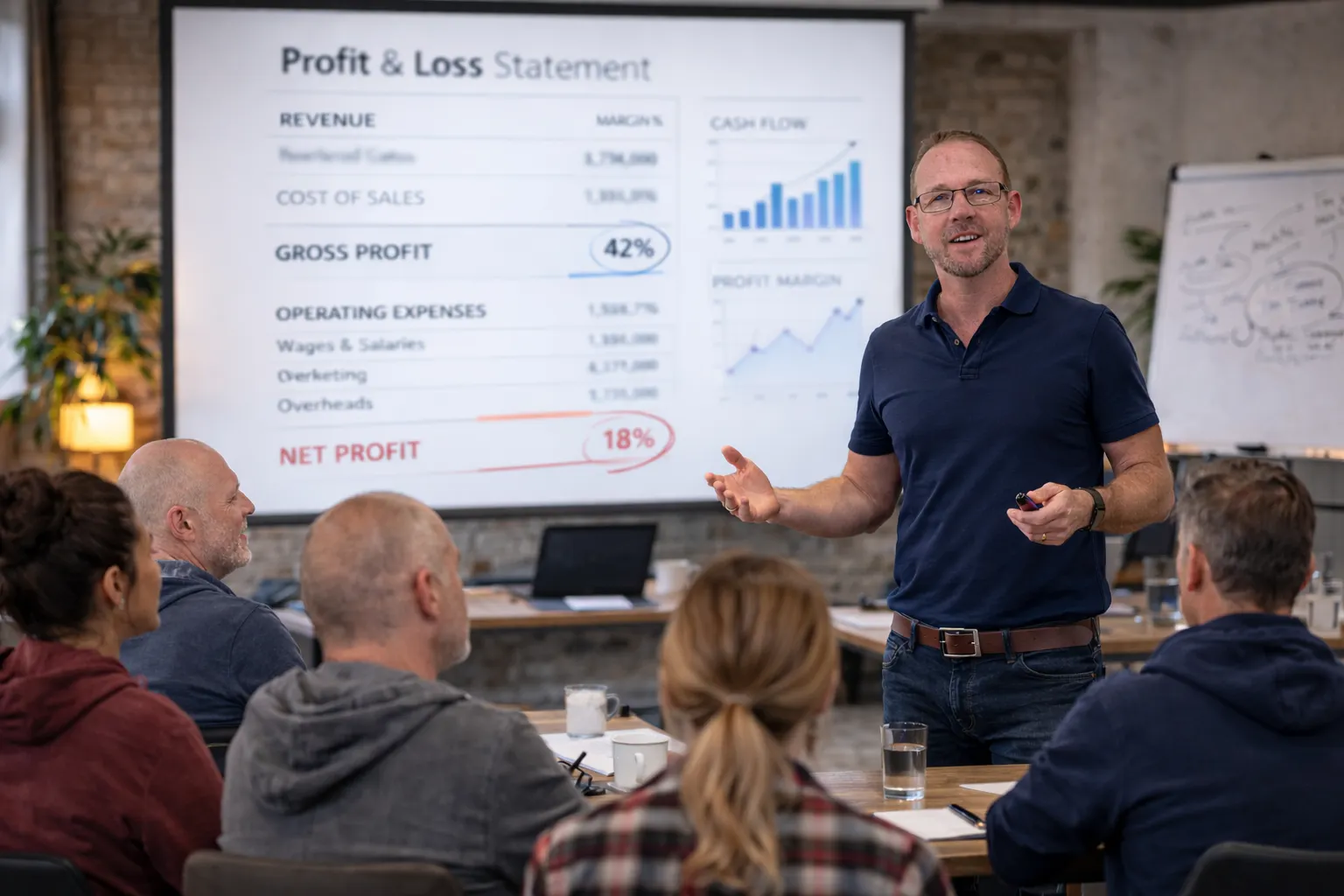
Revenue Growth Doesn’t Equal Profit Growth
-
Revenue grows, margin tightens
-
Decisions rely on instinct instead of clean data
-
Complexity outpaces systems
-
Effort increases, clarity declines
Profit Is a Discipline
Sustainable profit is structural. It requires visibility over the numbers, disciplined pricing, defined customer focus, weekly performance tracking, early issue resolution, and standardised execution.
Scale without discipline creates noise. Discipline creates clarity. Clarity creates control.
The Business Levers That Drive Profit and Control
Every business is different but these are the core levers that determine profit, stability and control.

Finances
Profit improves when the numbers are fully visible and understood across cash flow, margins, pricing and cost structure. When financial data is clear and current, decisions become deliberate rather than reactive. Financial clarity replaces guesswork with disciplined decisions and reduces unnecessary stress from growth.

Customers
Growth becomes unstable when every customer is treated equally regardless of fit or margin contribution. Not all customers contribute equally to profit, and unclear positioning weakens pricing power and delivery consistency. Defined segments strengthen margins and improve operational focus.

Marketing
Marketing underperforms when positioning and margin targets are unclear. Clear customer definition and commercial alignment improve lead quality and reduce wasted effort. Marketing follows positioning and margin clarity, not activity volume.

Team
People problems often reflect structural gaps rather than personality issues. Clear roles and measurable expectations create operational stability across the organisation. Structure creates consistency across the team, reducing friction and improving accountability.

Systems
Reliance on memory, urgency and constant supervision limits scalability. Documented processes and repeatable workflows stabilise operations and protect margins as complexity increases. Sustainable businesses depend on repeatable systems, not individual effort.

Time
Persistent time pressure usually signals misaligned priorities or unclear processes. When workflows are standardised and decisions are disciplined, capacity increases and reactive work declines. Time pressure reflects structural weakness, not workload alone, and correcting structure restores control.

Accountability
Knowing what should happen does not guarantee progress. Clear metrics and consistent review cycles convert intention into measurable movement. Clarity without accountability leads to drift, even when strategy appears sound.

Strategy / Planning
Without measurable targets, activity becomes reactive and scattered. Structured planning aligns daily execution with long-term direction and defines what matters most. Vision requires measurable structure to translate into results.

Execution & Progress
Ideas and plans create no value without disciplined follow-through. Consistent tracking and early issue resolution maintain momentum across projects and priorities. Plans matter only when executed consistently, with visible performance feedback.
How Structured Businesses Operate
Sustainable profit does not come from intensity. It comes from clarity, cadence and disciplined execution.
Clarify
Direction
Every business needs defined outcomes — revenue targets, margin expectations, customer focus and operational priorities. Clear direction reduces reactive decision-making.
Translate Vision Into Measurable Projects
Strategy becomes useful when it converts into specific projects, ownership and measurable milestones. Progress must be visible, not assumed.
Establish Operating Rhythm
Weekly visibility over financial and operational metrics keeps performance aligned. Regular review cycles reduce drift and surface issues early.
Review, Adjust, Improve
Markets shift. Capacity changes. Priorities evolve. Structured review prevents stagnation and maintains forward momentum.
Experience & Background
Darryl Tonks has built and led in environments where mistakes carry consequences.
He began in frontline operations, progressed into aviation as a commercial pilot, airline captain and operational trainer, and later moved into business ownership, government-accredited advisory and financial performance coaching.
Across his career he has:
-
Commanded commercial aircraft and trained pilots in high-consequence environments where discipline and precision were non-negotiable
-
Managed and developed teams within structured operating systems built for safety, accountability and performance
-
Acquired and rebuilt a struggling business from the brink of failure into a stable, profitable operation
-
Served as an NSW Government Accredited Business Advisor, working directly with business owners across industries
-
Worked with more than 450 business owners to start, stabilise, restructure and grow their operations
-
Supported established service businesses ranging from $300K to $10M in annual revenue to gain financial clarity, pricing discipline and operational control
His qualifications include Advanced Diplomas in Business and in Leadership & Management, along with a Certificate IV in Accounting & Bookkeeping.
The through-line across every role is consistent: remove noise, tighten structure, make the numbers visible, and build businesses that operate with control rather than intensity.
Profit is treated as an operational outcome - not a motivational target.